
If you’re somewhere between 35 and 55 and you’ve started Googling “why am I waking up at 3 a.m.” or “why am I so anxious all of a sudden,” you are not losing it. You’re likely in perimenopause — the 4-to-10-year hormonal transition that precedes menopause.
According to the Study of Women’s Health Across the Nation (SWAN), more than 80% of people in perimenopause experience moderate-to-severe symptoms, and the average duration is 7.4 years. That’s almost a decade of subtle (and not-so-subtle) shifts in sleep, mood, energy, and body composition.
At Lizard Yoga in Austin, we see this transition every day on our mats. And here’s what we’ve learned: the people who move through perimenopause with the most ease aren’t the ones who fight it — they’re the ones who learn to regulate their nervous system, build strength intentionally, and protect their sleep. Yoga is one of the most well-studied tools we have for all three.
This guide blends ancient practice with modern endocrinology. We honor where these tools come from. We also know your body is asking for evidence, not promises.
What’s actually happening in your body:
Perimenopause isn’t a single event — it’s a gradual decoupling of the feedback loop between your ovaries, pituitary, and hypothalamus. Estrogen and progesterone don’t decline in a smooth line. They oscillate, sometimes wildly. That oscillation is what produces hot flashes, sleep disruption, mood swings, brain fog, joint stiffness, and the now-famous “rage” that catches so many of us off guard.
Here’s the part most women aren’t told: declining estrogen also affects your autonomic nervous system. Estrogen modulates GABA (your calming neurotransmitter) and serotonin. When estrogen drops, your baseline can shift toward sympathetic dominance — what neuroscientist Dr. Andrew Huberman calls “elevated tonic arousal.” You feel wired. You can’t drop into sleep. Cortisol stays high.
This is why so many women in their 40s describe the same thing: “I used to be able to handle this. Now I can’t.” It’s not weakness. It’s neuroendocrine reality.
The good news: nervous system regulation is trainable. Yoga, specifically, is one of the few practices that down-regulates the sympathetic branch while simultaneously building the strength and bone density you need for the decades on the other side.
The five practices we recommend most
1. Slow vinyasa for blood sugar and mood: A 2019 randomized controlled trial published in Menopause found that 12 weeks of regular yoga reduced hot flash frequency by approximately 30% and significantly improved sleep quality in perimenopausal women. The mechanism is partly metabolic: slow, breath-paced movement improves insulin sensitivity, which matters because insulin resistance accelerates during perimenopause and worsens nearly every symptom.
What we teach: 45–60 minute slow flows where each movement is paired with a full breath cycle. No “power” classes during the 3 p.m.–evening window when your cortisol is already dysregulated.
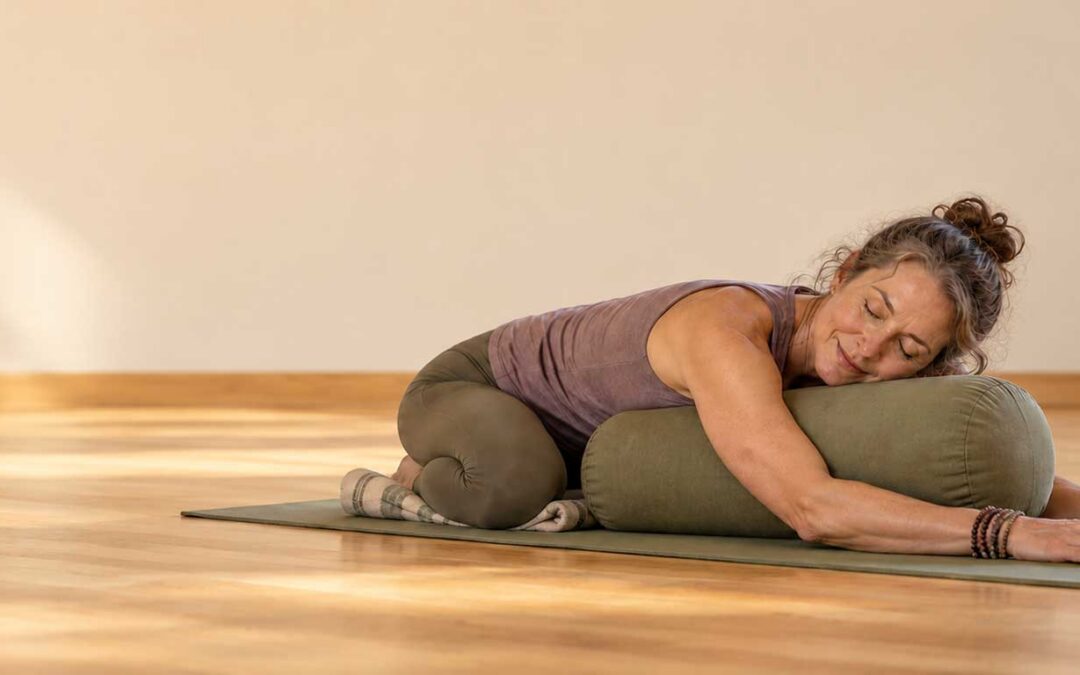
2. Restorative yoga for the HPA axis: Restorative yoga is the most under-rated tool in midlife. Long, fully-supported holds (8–20 minutes per pose) shift the body into parasympathetic dominance. Heart rate variability rises. Cortisol drops. A 2014 study in Psycho-Oncology showed measurable reductions in inflammatory markers after just eight weeks of weekly restorative practice.
If you wake up at 3 a.m. with your mind racing, this is the practice that retrains the system. Two restoratives a week is a therapeutic dose.
3. Strength-forward yoga for bone and muscle: Estrogen is protective for bone. As it declines, bone mineral density can drop 1–2% per year in early postmenopause. Muscle mass declines too — a process called sarcopenia. The fix is mechanical load.
This is where modern yoga and modern exercise science meet: longer holds in chair pose, warrior II, side plank, and standing balances generate the muscular tension that signals bone to maintain density. Andrew Huberman has been vocal that “resistance training and load-bearing exercise are non-negotiable past age 40” — and a well-built yoga class delivers exactly that, with the bonus of joint mobility most strength programs miss.
4. Pranayama for hot flashes and sleep: A small but striking 2018 study in the Journal of Mid-Life Health found that slow-paced breathing (5–6 breaths per minute) reduced hot flash severity by 44% in women who practiced for 15 minutes twice daily over eight weeks. The mechanism: slow nasal breathing increases vagal tone, which directly modulates the thermoregulatory centers in the hypothalamus — the same centers that misfire during a hot flash. The “physiological sigh” — two short inhales followed by a long exhale, popularized by Huberman’s lab at Stanford — is another two-minute reset that works in real time. We teach it in every class.
5. Yoga nidra for sleep architecture: If you only have 20 minutes, this is what we’d choose. Yoga nidra is a guided body-scan practice that produces brainwave patterns similar to slow-wave sleep. A 2023 review found that consistent yoga nidra improved sleep onset latency, total sleep time, and subjective sleep quality in midlife women. Many of our Austin students use it three nights a week instead of melatonin.
What inclusive practice actually looks like
Perimenopause doesn’t just happen to cis women in their late 40s. It happens to people who menstruate, including some non-binary and trans folks, often starting earlier than expected. It happens to women with PCOS, who may transition earlier. It happens to people after chemotherapy or oophorectomy at any age. It happens to those of us who never had children and to those of us who had five.
At Lizard Yoga, our classes are built so that the language and modifications work for every body in the room. You will not be told what your hormones should be doing. You will be given options and encouraged to listen.
A weekly practice we’d actually prescribe
If you have three hours a week, here’s how we’d spend them:
Monday morning: 60-minute slow flow (cortisol regulation, blood sugar, mobility)
Wednesday evening: 75-minute strength-forward yoga (bone, muscle, balance)
Friday evening or Sunday morning: 60-minute restorative or yoga nidra (HPA axis, sleep)
Daily, 5 minutes: slow nasal breathing (4 in, 6 out) before bed
Three classes a week is the dose where most of our Austin students start reporting better sleep within 3–4 weeks and noticeably fewer hot flashes by week 8. Bryan Johnson, who has built his entire Blueprint protocol around what’s measurable, has been blunt that “the people who age well are the people who train consistently — not perfectly, consistently.” Yoga makes consistency possible because it doesn’t wreck you.
What our community says
⭐️⭐️⭐️⭐️⭐️
Lizard has become the go-to place for my family for yoga over the last two years. Every teacher is great, the atmosphere is awesome, and they do such a great job with lighting, aromatherapy, temperature, etc. Definitely recommend!
⭐️⭐️⭐️⭐️⭐️
Lizard yoga has so much to offer and I always have a wonderful experience! I’ve done the sauna and cold plunge, many yoga classes and women’s circle events. The space is so welcoming and calming to my nervous system. I highly recommend sitting in the Himalayan salt room with a cup of tea and no phone 🙂
⭐️⭐️⭐️⭐️⭐️
I’m so happy that I found Lizard Yoga when I moved to Austin. The teachers and community are wonderful. I appreciate the breadth and variety of classes, as well as the other amenities on site. 7:30 Morning Flow with Ally is truly the BEST way to start the day!!
⭐️⭐️⭐️⭐️⭐️
I’ve been attending Lizard Yoga classes for almost a month now. I was initially interested in them because I was looking for somatic yoga classes specifically to bring inner calmness to my nervous system. I’ve tried multiple classes and all of their instructors are amazing. The staff is nice and I love their dog mascot Cash who greets you at the door when he’s there. The main thing is that they are supportive and I can honestly tell the difference in my body since I’ve been doing the work. This is a great studio.
Come try it
If you’re in Austin and you’ve been wondering whether yoga can actually move the needle on what perimenopause is doing to your body, the answer — based on the data and on what we watch happen in our studio every week — is yes. Not as a magic bullet. As a practice that compounds.
Your first class at Lizard Yoga is on us. Come find a mat. Bring nothing. We’ll meet you where you are.
Book your first class → lizardyoga.com/schedule/
This article is for educational purposes and is not medical advice. If you are experiencing severe perimenopausal symptoms, please consult a physician — ideally one trained in midlife hormonal health. We’re happy to recommend Austin-based providers our community trusts.